Last Supper

Big Is It?

It's huge, really - 460 x 880 cm (15 x 29 feet). It covers an entire large wall, very unlike reproductions sized to hang neatly behind one's sofa.

Where Is It?

The original mural is on a wall of the refectory (dining hall) in the Convent of Santa Maria delle Grazie in Milan, Italy.
If you'd care to see a reproduction or fifty, they're easily found. As an image, Last Supper has been put on everything from mirrors, to mouse pads, to musical pillows. If Leonardo were still around, he'd be earning billions of (insert your currency here) on licensing fees alone.

How Long Did it Take Leonardo to Paint This?

He began working on it in 1495, and finished Last Supper in 1498. This is worth noting, as Leonardo was a known procrastinator with a marked tendency to leave projects unfinished.

Why Is the Composition Remarkable?

First, because the disciples are all displaying very human, identifiable emotions. "The Last Supper" had certainly been painted before. Leonardo's version, though, was the first to depict real people acting like real people.
Secondly, and of major importance - the technical perspective in Last Supper is incredible! You can see that every single element of the painting directs one's attention straight to the midpoint of the composition, Christ's head. It's arguably the greatest example of one point perspective ever created.

What Does Last Supper Depict?

Last Supper is Leonardo's visual interpretation of an event chronicled in all four of the Gospels (books in the Christian New Testament). The evening before Christ was betrayed by one of his disciples, he gathered them together to eat, tell them he knew what was coming and wash their feet (a gesture symbolizing that all were equal under the eyes of the Lord). As they ate and drank together, Christ gave the disciples explicit instructions on how to eat and drink in the future, in remembrance of him. It was the first celebration of the Eucharist, a ritual still performed.
Specifically, Last Supper depicts the next few seconds in this story after Christ dropped the bombshell that one disciple would betray him before sunrise, and all twelve have reacted to the news with different degrees of horror, anger and shock.

Who's in It?

Looking across the picture from left to right:
  • Bartholomew, James Minor and Andrew form a group of three. All are aghast, Andrew to the point of holding his hands up in a "stop!" gesture.

  • Judas, Peter and John form the next group of three. Judas, you will note, has his face in shadow and is clutching a small bag (of silver?). Peter is visibly angry and a feminine-looking John seems about to swoon.

  • Christ is the calm in the midst of the storm.

  • Thomas, James Major and Philip are next. Thomas is clearly agitated, James Major stunned and Philip seems to be seeking clarification.

  • Matthew, Thaddeus and Simon comprise the last group of three figures. It appears that, when a situation turns ugly, Simon is the "go to" guy for explanations.

Why Is it Falling Apart?

Leonardo, always the inventor, tried using new materials for Last Supper. Instead of using tempera on wet plaster (the preferred method of fresco painting, and one which had worked successfully for centuries), he thought he'd give using dry plaster a whirl. His experiment resulted in a more varied palette, which was Leonardo's intent. What he hadn't taken into account (because, who knew?) was that this method wasn't at all durable. The painted plaster began to flake off the wall almost immediately, and people have been attempting to restore it ever since.

Why Doesn't Jesus Have Feet?

Rest assured, Leonardo intended for Christ to have feet and, in fact, painted them. Around 1650, some unnamed, woefully misguided soul - on a mission to insert another door into the refectory - apparently decided that the only logical spot for said door was smack dab in the middle of that wall. We probably shouldn't grumble and just consider ourselves lucky that he wasn't engineering windows.

I Heard This Story About Last Supper. Is it True?

Do you mean the story in which Leonardo first paints Jesus Christ, after searching many months for the perfect model? And then, years and years later, after painting all eleven other disciples, has an even more grueling search for the perfect model for Judas? And - amazingly - the same person ends up being the model for both? That story?
No, it's not true, and for so many reasons (all of which are detailed in a piece at Snopes). It's a neat bit of fiction, though, complete with a moral.

San Giovanni Battista

"San Giovanni Battista" (Saint Joseph) c.1513-15.

Madonna and Child with a Pomegranate


The workshop of a Renaissance artist was both studio and school, where apprentices were trained to paint in the style of the master. Since large commissions required the efforts of many painters, backgrounds, still-life details, and secondary figures were often painted by assistants. A master might also give lesser commissions entirely over to his assistants, simply approving the work as meeting his standard. It is often difficult to distinguish the work of the master from that of talented assistants whose individual styles were not yet fully developed.

This small devotional panel is painted in the style of Andrea del Verrocchio but is the work of one of his students, Lorenzo di Credi, who inherited the workshop when Andrea died. For inspiration Credi seems also to have looked to a fellow student—Leonardo da Vinci. This madonna is modeled after one by Leonardo; in fact, the painting was once thought to be an early work by Leonardo. But the colors differ from Leonardo’s subdued palette, and the landscape lacks his fanciful mountains. Notice, too, the Virgin's left hand, which holds a pomegranate, symbol of the Resurrection. In Leonardo's painting she holds a carnation. Credi failed to alter the position of her fingers, leaving her with an unnatural gesture unthinkable from such a keen observer of nature as Leonardo.

Madonna Litta

Madonna Litta 1481-97

The attribution of this painting to Leonardo remains controversial. It is now generally agreed that while it may have been based on designs by Leonardo, it was probably brought to completion by Giovanni Antonio Boltraffio, who was a pupil of Leonardo’s in the master’s Milanese workshop under the master’s supervision.

This small painting of the Madonna and Child was a popular image type in Italy during the 15th century and was probably intended for private devotion. The overall design with the Madonna and Child situated within a dark interior with windows providing a view of a distant mountain landscape behind is typical of earlier paintings by Leonardo, such as the Madonna and Child with a Carnation and the so-called Benois Madonna.

However, the harsh outlines of the forms and the rather formulaic landscape that lacks atmosphere indicate that the painting is not the work of Leonardo himself, but that of his assistant Boltraffio, who employed a figural type similar to that of the Christchild in other paintings.

The study of a Woman’s head almost in profile, a drawing in silverpoint on greenish prepared paper by Leonardo, probably based on a life model, seems to have been used for the modelling of the Virgin’s head, implying that Leonardo was at least involved in the initial design of the painting.

Leonardo’s Madonna dei Fusi

Leornado da Vinci spent some five years living and working in and around Arezzo and the city is proud to host his painting ‘La Madonna dei Fusi’ for five months.

The painting was commissioned in 1501 by Florimond Robertet, secretary of state to Louis XII.

The version of this painting (Buccleuch version) often regarded as the most likely to be by Leonardo is in the collection of the Duke of Buccleuch and hung in his home in Drumlanrig Castle, Dumfries and Galloway, Scotland until stolen; he has said it will be returned to public display there.
History of Leonardo’s Madonna dei Fusi

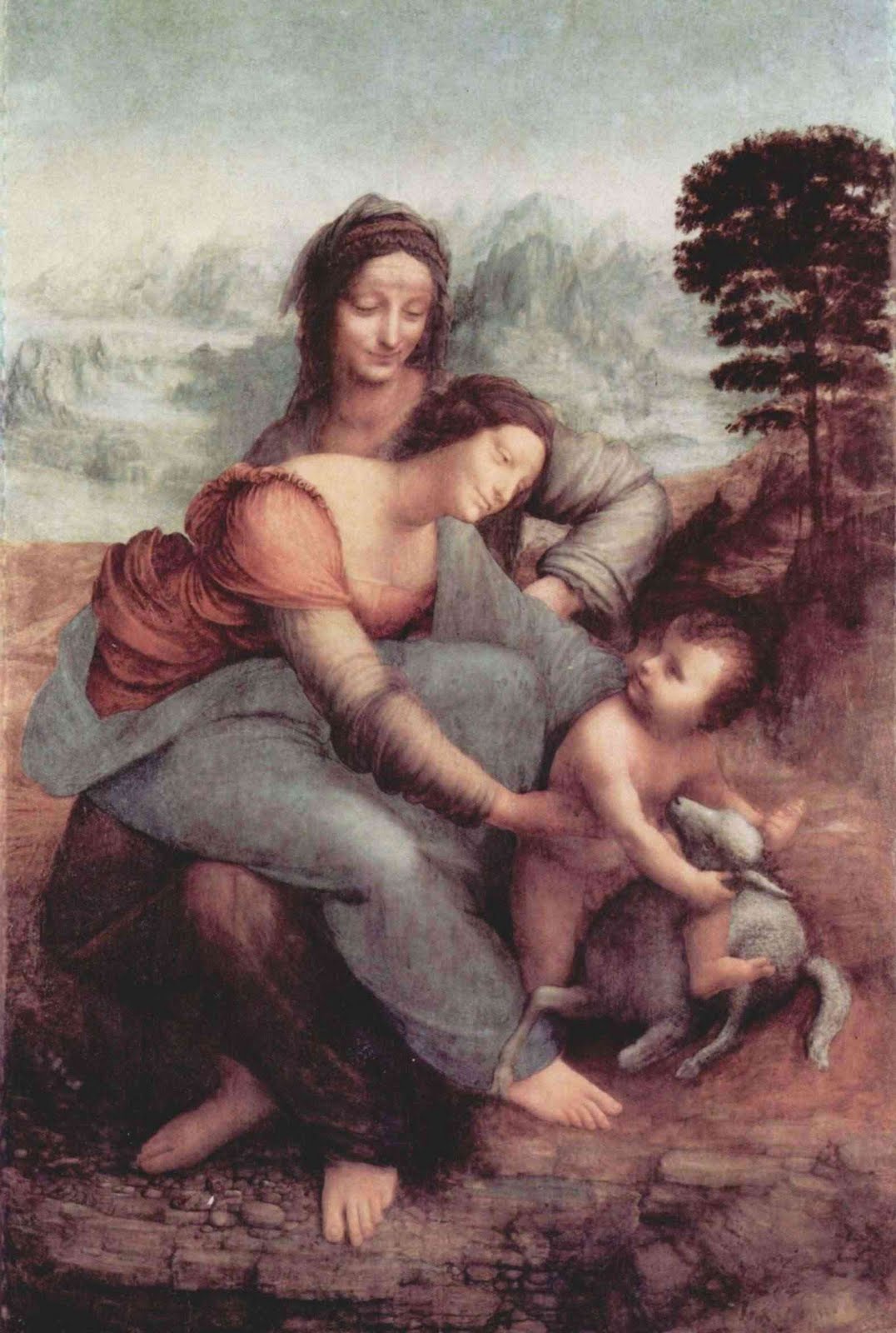
The Virgin and Child with St Anne


leonardo first explored the topic of the Virgin and Child with Saint Anne around about 1498. His original sketch is now lost to us, but in the one illustrated below, commonly termed the Burlington House Cartoon, the infant Christ is shown blessing a young St. John during a meeting in the desert. This is only one of many sketches on the theme that was never translated into a painting; Leonardo was to entirely abandon these earlier ideas. Cartoons are preparatory large-scale drawings intended to be transferred to a wall or canvas during the final painting; this one was named after the British collection which once owned it. Many scholars prefer the Burlington House Cartoon to Leonardo's completed oil painting, pointing out how the face of the Madonna is much more natural and less wooden looking.

The Burlington House cartoon covers eight sheets of tinted paper and is drawn in charcoal with chalk highlights. It is one of the most important works in the National Gallery, London who keep it in a darkened room to prevent fading. When originally exhibited in Florence this cartoon received an acclaim almost comparable to that of a completed painting and it has long been considered one of Leonardo's finest works, easily on a par with the Last Supper. Though Leonardo never painted this cartoon it inspired another artist to produce the Virgin and St. Anne which is in the collection of Professor Lauritz Weibull of Lund, Switzerland.

The oil painting of the Virgin And Child With St. Anne is thought to date from 1507-1513. We owe this panel to the modesty of Filippino Lippi who turned down the commission and suggested Leonardo as, "a greater artist".

An account of the cartoon for this painting indicates it may have been modified at some stage, perhaps as an afterthought. A description of the original sketch describes St. Anne as restraining her daughter from discouraging the Child in pulling the lamb's ears. This is not what can be seen today; our view is of a rather detached watching grandmother. It is quite possible the original concept for this painting had St. Anne's hand lying on her daughter's sleeve; this could easily be cancelled out by painting the Virgin's sleeve over the top of it.

In the painting the infant is shown holding a lamb, this is symbolic of himself, as Jesus is often termed the 'lamb of God'. The angle of the lamb's head, and the tight woolly curls repeated on the head of the Child, connect the two. Continuing the idea of connections, Leonardo has positioned the two sets of arms like links in a chain. Atop the chain is St. Anne, slightly set apart in the composition by the line of the Virgin's shoulder, her downward glance and the use of darker skin tones on her face. Behind them the trees definitely belong to the earth while the mountains and lake seem almost heavenly. Though this work has been much acclaimed, it has also been much criticised due to the very artificial poses.

The five by four foot painting was commissioned by the monks of the Santissima Annunziata in Florence for their high altar. Some consider this painting to be a treasure of esoterica and occult wonders. Some are fascinated by the sight of St. Anne supporting her heavy daughter on her knee, and with no visible means of support. Others are convinced that hidden in the folds of the draping over the arms is the shape of a vulture, the head and neck can be found in the blue cloak encircling the Madonna and the bird's tail points towards the infant's mouth. Most are skeptical about this idea, though Dr. Sigmund Freud supported it and claimed that it was a repercussion of a fantasy Leonardo had when he was a child and which he noted in Codex Atlanticus:

"Among the first recollections of my childhood it seemed to me that, as I lay in my cradle, a kite came to me and opened my mouth with its tail and struck me several times with its tail between my lips. "

Freud saw this as a "passive homosexual fantasy" and thought it also accounted for the strange and bewitching smiles on the lips of many of Leonardo's subjects.

The Virgin And Child With St. Anne has been retouched, and was left unfinished with the drapery covering the Virgin's legs being little more than an outline. Why is unknown, though it may have been due to Leonardo's increasing interest in mathematics and subsequent engagement as engineer in the service of Cesare Borgia. In places the paint has been applied so thinly it is almost transparent allowing the underlying sketch to be visible. The appearance of this worsened after a 1953 cleaning of the oil on wood artwork, during which overpainting was removed and dark varnish lightened.

A close study shows the lamb has been completed by another artist so the painting may have been abandoned at a time when the lamb had still only been sketched in. The background, St Anne, the Virgin and the Child are thought to be from the hand of Leonardo himself though some doubt exists about the heads as they lack the fine texture of the Mona Lisa. Suggestions have been made that these were worked on by a pupil of Leonardo's.

At the same time this painting was in progress Leonardo was experimenting with preparations which he hoped would result in an improved varnish for his work; unfortunately these experiments were a failure. This mattered little; Leonardo still had 10 years to live, but by 1508 his career as a painter was drawing to a close and after maybe as much as ten years of intermittent work on this painting he gave up.

With Leonardo not completing Virgin and Child with St. Anne in time for the altar, Filippino Lippi decided to return to the task, working on a Deposition. He was to die before having the chance to finish his painting and it was finally completed later by Perugino.

Mona Lisa - leonardo da vinci


Leonardo Da Vinci's Mona Lisa is one of the most famous and most celebrated works of all time. The mastery of the painting lies in its subtle detail, including the faint smile, and Mona Lisa's distinctive gaze. The work is said to have been commissioned by a gentleman named Francesco del Giocondo, who hired Leonardo to paint a portrait of his wife, and this is why The Mona Lisa is sometimes referred to as La Gioconda. While this is a theory on the origination of the painting, scholars have disagreed throughout the ages about how factual this story really is.

The Mona Lisa, aside from being one of the most recognized works in the history of art, is also one of the most widely reproduced works ever. Of course there are numerous Da Vinci posters available, many of which are of The Mona Lisa, available in different hues and a variety of sizes, there are also many other reproductions of the work. For instance, Andy Warhol used the Mona Lisa in the creation of one of his prints, and Botero reproduced his own version of The Mona Lisa, a cartoon-like oil painting. In 1954, Salvador Dali created a self-portrait of himself as Mona Lisa.

The use of The Mona Lisa does not end there; The Mona Lisa has been the inspiration behind countless novelty items including clothing, jewelry, houseware, as well as having been used in many modern day advertisements. La Gioconda has even been reproduced topless, and the Da Vinci poster has been turned into a mockery with the Mona Lisa in possession of marijuana, and even sporting hair curlers or braces.

The list goes on and on, and it is probably safe to assume that the Da Vinci posters and the extraordinary painting will continuously be tampered with to create a new Mona Lisa time and time again.